
From Automation to Intelligence | How ServiceNow’s Now Assist is Redefining Workflows
By: Antonio G.
To truly understand the power and utility of ServiceNow’s Now Assist native AI layer, it is important to look in the rear-view and recognize the path it took to get here. From humble beginning as a simple ticketing system built around workflow automation ServiceNow has matured into an intelligent ecosystem capable of understanding context and making informed decisions. ServiceNow continues to evolve and reimagine what automation looks like through four industry defining phases and what they mean for how we get our work done.
-
-
Deterministic Automation
-
Predictive Machine Learning
-
Generative Assistance
-
Agentic
-
Phase 1 (Deterministic Automaton):
This era was defined by tools such as Flow Designer, business rules, approvals and SLAs all configured within the platform. The strength of this period also happens to be its weakness. These solutions depended entirely on human intervention to configure in advance for every single choice, decision and outcome. The system was limited with these pre-defined solutions and could only ever do what someone had already designed it to do. Not learn, not anticipate, nor exercise any judgement.
Phase 2 (Predictive Machine Learning):
From 2018, ServiceNow began layering Machine Learning into the platform. Tools like Predictive Intelligence and early iterations of Virtual Agent had the ability to classify and route various tasks. This required several hours of training large sets of consistent data that would go from your instance to ServiceNow’s servers. Then, it would have to learn patterns and delete your data before sending back a functional model whose abilities were limited to predicting a record’s categories and assignment group. As data and requirements changed, so would the need to retrain models from scratch. During this time, there was significant progress towards automation. However, there were limitations where the system never learned on its own and output was only as good as the inputted data.
Phase 3 (Generative Assistance):
Now Assist was launched in 2023, powered by a domain specific ServiceNow LLM tuned for enterprise and data privacy. It spanned ITSM, CSM, HRSD, with Creator following shortly after. It offered features like Virtual Agent, text summarization, natural language code-to-text, and flow generation. The output seen here is far beyond the value of Phase 2’s Predictive Machine Learning of predicting fields. The platform produces artifacts, such as generating summaries, replies, or drafts, then hands the results to its human counterparts to review, edit, and act on. On its own, generative assistance is unable to validate and execute the next step without verifying its accuracy, and this responsibility falls on the human.
Phase 4 (Agentic):
ServiceNow announced its Agentic AI strategy in 2024, standing on the shoulders of Now Assists Skill kit. Where Skills require a trigger in order to act, an AI Agent can be handed an entire task and work through it on its own. With the ability to reach into flows, published Skills, and direct record actions, an orchestrator sits above Agents to manage several at once and decide what the next steps are. Meanwhile, the human becomes somewhat of a supervisor, overlooking and getting involved as needed. The relationship with these tools matures into a collaborative colleague who can execute work on your behalf and then ask for guidance and approval in order to get the job done.
Now Assist as a toolbox, not a feature:
Now Assist cannot be summed up as a simple AI feature but more so an entire layer stacked throughout the platform. Think of it like a toolbox full of several tools, each with its own unique purpose, like a hammer versus a screwdriver. Skills are like single purpose tools themselves, with generative actions like summarizing an incident or drafting a reply. Whereas the Now Assist panel is like a tool belt which holds all Skills, making them accessible and ready to use. The Admin Console is like the lock on the toolbox, ensuring that only those authorized can get to it.
The Generative AI controller is the power source that fuels these tools, it’s the actual language model and driving force behind each action. The controller runs on ServiceNow’s own domain tuned model by default, with the flexibility to swap to OpenAI, Azure OpenAI, Aleph Alpha, IBM WatsonX, and Google Gemini if needed. For jobs that require a new Skill that does not already exists, Now Assists Skill Kit is like a workbench to build one. Lastly, AI Agents are the helping hand that can take on entire tasks. They reach into our metaphorical toolbox on their own and pick the right Skill/tool for the job, completing it and moving on to the next task.
Where the manual effort gets taken off our plate:
This is where the worth becomes very obvious. Now Assist helps end users extract immediate value across three core ServiceNow workflows, ITSM, HSRD and CSM, by slashing down on time reading, retyping, and increasing time available for actually working. This allows them to focus where it really matters without being bogged down with repetitive tasks and increases their productivity.
In ITSM, a record summary gives the agent incident context on past actions and resolution notes are drafted automatically from steps already taken. In HRSD, HR Case Managers can generate case summarization similar to ITSM. However, the big distinction is that cases related to harassment and misconduct are routed directly to humans and not AI, allowing for real judgment on the matter rather than pure automation. Lastly, automation features inside CSM go a bit further than just case and work note summarization. You can generate drafts rooted in the actual case history and triage cases using agentic workflows that can manage duplicates and routing before a human is ever involved.
Across all three (ITSM, HSRD, CSM) AI can manufacture a starting point and editable draft, all while allowing the human to maintain control and dictate which actions are taken. It’s also worth noting that all three are independent from one another and could be made active without impacting on the others.
Business case: Faster Resolution = Better Experience for all
So, what does this value actually look like in practice? I’m sure we’ve all heard of the luxury car brand Rolls-Royce. Well, they’re a heavy user of the ServiceNow platform and champion these tools, implementing them across their business and service delivery components. In a case study published by ServiceNow, Rachel Cameron, VP of Performance and Improvement, described adoption of digital self-service nearly tripled. Approximately 38,000 tickets were deflected in a single calendar year, as well as reducing resolution time by 34%.
On the FedRAMP side of things, Leidos has expanded its use of the ServiceNow AI Platform across roughly 50,000 employees and gaining approximately $3M+ in annual savings from AI driven assistance. Under the same breath, ServiceNow’s AI related subscription revenue has risen by 24.5%, year-over-year in Q2 2026. Although stats are measurable and look fun on paper, let’s not lose sight of the day-to-day and ticket-to-ticket value. Ultimately, agents spend less time on context assembly and instead produce results which transfer that value to the people who need it. Uplifting both the people providing the service and those who receive it.
Where to now?
Up until this point, we have seen ServiceNow evolve through four different phases: Deterministic Automation, Predictive Machine Learning, Generative Assistance, and Agentic. Across each of these phases, one trend holds true that raises a harder question: what is phase 5? Each phase asked less of us from one phase to the next. We went from configuring everything, to predicting some of it, to draft and reviewing, to then take action without being told. Now Assist is truly stepping closer and closer to true intelligence, one workflow at a time. As of Knowledge 2026, Now Assist is donning a new team jersey under the Otto branding, joining the ranks of Moveworks and AIx, which was acquired by ServiceNow in December 2025.
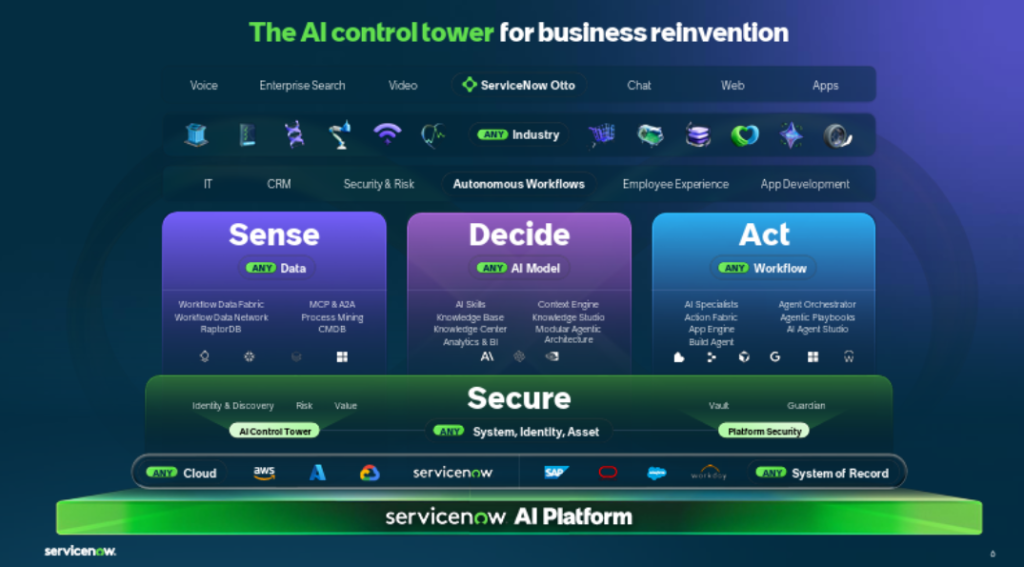
The same week Otto launched, ServiceNow announced Action Fabric, which opens its platform doors to outside agents built on Claude, Copilot and other AI stacks. Allowing them to execute work such as flows, playbooks, approvals, catalog items within ServiceNow directly. Every action, regardless of which agent triggered it, all goes through AI Control Tower for identity verification, permission, and audits. Regardless of which agent completed the work, the pivot becomes more governance surrounding who did what on the platform, under what authority, and what was the result. Configuration led to prediction, prediction led to drafting, drafting led to action, and now action is up for grabs for any agent fit for the job. In the end, we all win as ServiceNow continues to unify our AI experience under one roof. This gives organizations a single, trusted place to orchestrate work through a diverse ecosystem of Agents.
References
ServiceNow Newsroom, “ServiceNow expands AI Control Tower…”(May 2026) – https://newsroom.servicenow.com/press-releases/details/2026/ServiceNow-expands-AI-Control-Tower-to-discover-observe-govern-secure-and-measure-AI-deployed-across-any-system-in-the-enterprise/default.aspx
ServiceNow Newsroom,”Leidos reimagines experiences for 50,000 employees…”(July 2026) – https://newsroom.servicenow.com/press-releases/details/2026/Leidos-reimagines-experiences-for-50000-employees-and-boosts-operational-efficiency-with-the-ServiceNow-AI-Platform/default.aspx
ServiceNow Newsroom, “ServiceNow Reports Second Quarter 2026 Financial Results”(July 2026) – https://newsroom.servicenow.com/press-releases/details/2026/ServiceNow-Reports-Second-Quarter-2026-Financial-Results/default.aspx