

Building a Single Source of Truth with ServiceNow Discovery | Discovery
By: Dylan N.
Maintaining an accurate Configuration Management Database (CMDB) depends on having a reliable way to identify what exists in your environment and keeping that information up to date as things change. Manual updates and static data sources are typically insufficient in keeping timely and accurate information in a modern, dynamic IT environment. ServiceNow Discovery is designed to automatically identify and map devices, applications, and infrastructure across your environment to provide a real-time view of the CMDB.
How Does ServiceNow Discovery Identify and Map Your Environment?
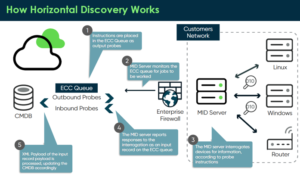
Horizontal discovery is the core approach used by ServiceNow Discovery to identify what exists. It scans networks and environments broadly, starting from IP ranges and endpoints, to build a comprehensive inventory of devices, infrastructure, and applications.
Discovery executes through MID Servers deployed within your environment. The MID Server initiates outbound communication to the ServiceNow platform and interacts with the infrastructure via standard protocol and cloud-native APIs. This allows Discovery to be executed across on-premises, cloud and hybrid environments without the need for inbound network access to the ServiceNow platform, while still providing broad visibility.
Probes, Sensors, and Patterns
Discovery relies on three core components to identify and process configuration data: probes, sensors, and patterns.
Probes and sensors are scripts that work together to collect and interpret data from target systems. Probes are designed to explore devices and systems on your network. Once the sensor has processed and parsed the data, it will be ready to be reconciled into your CMDB. ServiceNow has many out-of-the-box probes and sensors that can be customized to collect additional information.
Patterns perform a similar function but are used at a later stage in horizontal discovery. Patterns are written in Neebula Discovery Language (NDL) rather than JavaScript and are used to define a structured set of actions used to discover specific types of technology or applications and determine which attributes should be collected. Patterns are particularly useful for discovering complex technologies and custom applications. In addition to the default patterns, you can also create additional patterns or customize existing ones using Pattern Designer.
The Phases of Horizontal Discovery
ServiceNow Discovery follows a defined sequence of phases that progressively build an accurate picture of your infrastructure:
Scanning
Horizontal discovery is initiated with a probe (referred to as Shazzam) sent to scan your network and find all active devices. This probe identifies the most common open ports and identifies which of those ports respond to queries. For example, if a device responds to port 135, ServiceNow Discovery can reasonably conclude that the device is a Windows system.
Classification
After ServiceNow detects a device, it uses further probes to determine the type of device discovered and which operating system it is running. Classifiers define which probes or patterns ServiceNow should trigger in the next phases.
Identification
During the Identification phase, Discovery identifies further characteristics and determines whether a corresponding CI already exists in the CMDB. Identification rules define what attributes will be used to match the discovered attributes to existing CIs in the CMDB. Upon completion of this phase, Discovery can either create a new CI or update an existing CI to accurately represent the CI in the CMDB.
Exploration
In the exploration phase, Discovery gathers detailed data on the system, including installed applications, hardware attributes, and configuration information. Discovery also defines the relationships between systems and applications.
Discovery does not write records directly to the CMDB without validating the data first. All data collected during the discovery process is processed through the Identification and Reconciliation Engine (IRE) before writing to the CMDB. The IRE determines if the incoming data represents a new configuration item or an update to an existing configuration item based on identification rules and class definitions.
Establishing an Accurate CMDB Foundation
By automatically identifying devices, applications, and infrastructure and continuously reconciling that data into the CMDB, ServiceNow Discovery establishes the necessary foundational layer required for accurate configuration management. Rather than being a static inventory, with ServiceNow Discovery, the CMDB is continually updated to reflect the changes in your environment.
Sources from ServiceNow Documentation:
Get Started with Discovery: Exploring Discovery
Discovery Process Flows: Horizontal discovery process flow with probes and sensors
Discovery Process Flows Patterns: Horizontal discovery process flow with patterns