

Gain End-to-End Visibility Across Your Software Portfolio | Software Asset Management
By: Grace H.
SAM and IRE
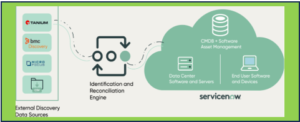 A strong Software Asset Management (SAM) practice really starts with having a single, accurate view of what’s running across your environment. When SAM is tightly integrated with Discovery and the CMDB, it brings together technical data, operational insights, and governance needs in one place—giving IT, procurement, and compliance teams a shared, reliable source of truth.
At the center of this ecosystem is ServiceNow’s Identification and Reconciliation Engine (IRE). The IRE doesn’t simply transport data into the CMDB; it acts as a safeguard, ensuring that what ends up in your CMDB is dependable and consistent. It identifies CIs correctly, reconciles attributes, and blocks duplicate entries before they clutter or compromise the integrity of your system. With this foundation in place, SAM can trust the data it’s consuming, Discovery can deliver clean and consistent results, and teams across the organization gain the visibility needed to make confident decisions.
Understanding How the IRE Supports SAM and Discovery
The Identification and Reconciliation Engine (IRE) is what makes clean, reliable CMDB integrations possible when working with third-party discovery tools. It plays a key role in protecting CMDB accuracy by preventing duplicate configuration items (CIs) and reconciling attribute-level differences. Once data is received, the IRE processes it, applies identification logic, and places it into the correct CMDB tables. These rules can also be extended to flow the right information into Software Asset Management (SAM) tables, creating alignment across the CMDB and SAM.
Each CI includes a CI Identifier rule tied to the Hardware [cmdb_ci_hardware] class. When a third-party discovery tool runs, it generates a payload that is sent to your instance. This payload inserts or updates records in the CMDB according to the identification rules, ensuring that incoming data aligns with what already exists rather than creating unnecessary duplicates.
Software discovery follows a similar pattern. If multiple discovery sources report the same software with identical attributes, the installation record is updated. When values differ, discrepancies appear in the Software Installation [cmdb_sam_sw_install] table, so SAM has visibility into variations across sources. The SAM Deduplication process then evaluates matching values, keeping a single installation active and marking duplicates as inactive—promoting clarity and reducing noise.
Important Domain Separation Considerations
When domain separation is involved—especially in environments using third-party discovery with SAM—there are a few critical points to keep in mind:
- The domain you’re logged into during the REST call is the domain the IRE REST API will stamp onto the record.
- Always operate within the domain where the CI actually exists and where the payload should originate.
- Avoid running updates from the parent domain, as this can unintentionally update an existing CI and create a new one.
- In short, the payload must come from the same domain as the CI to maintain data consistency and prevent cross-domain mismatches.
This attention to domain alignment ensures that CMDB, Discovery, and SAM remain synced and that the IRE can do its job effectively.
Integration of SAM, Discovery, and the CMDB
When SAM, Discovery, and the CMDB are working together the way they’re designed to, the organization gains far more than clean records—it gains true visibility into its software footprint. This integration enables accurate software tracking, earlier detection of discrepancies, and stronger support for compliance and cost optimization.
With the IRE managing identification and reconciliation behind the scenes, teams across IT and procurement can rely on a single, unified view of their software assets. The result is more confident decision-making, fewer unexpected issues, and a SAM program that supports the business instead of getting pulled into constant clean-up work.
Sources From ServiceNow Documentation:
Identification and Reconciliation Engine (IRE): Identification and Reconciliation engine (IRE)
Software Asset Connections: Software asset connections