
Strengthen Security and Compliance with Continuous Discovery | Discovery
By: Dan N.
How Can You Secure What You Cannot See?
Enterprise IT has never been more distributed, or more exposed. Cloud sprawl, containerized workloads, edge devices, and shadow IT create a rapidly growing and often invisible attack surface. IT teams are tasked with securing environments they don’t fully understand, protecting assets they can’t see, and proving compliance against controls they can’t enforce.
This is the security paradox: we can’t protect what we can’t find.
To address this, many organizations rely on ServiceNow Discovery as the first step in their cybersecurity and compliance strategies. But the reality is: one-time scans or occasional Configuration Management Database (CMDB) updates aren’t enough. Vulnerabilities change daily; assets spin up and down in seconds, and audit windows never wait for cleanup projects. What’s needed is a shift in mindset, from static inventories to dynamic, living and breathing Configuration Items (CIs) ecosystems.
Continuous Discovery turns asset visibility into a real-time operational practice, giving teams the context they need to reduce security blind spots, detect unauthorized changes, and respond to risk before it becomes breach or regulatory penalty.
The starting point for all of this is to understand a character flaw in ServiceNow’s approach to Network situational awareness.
ServiceNow Is “Network Blind”
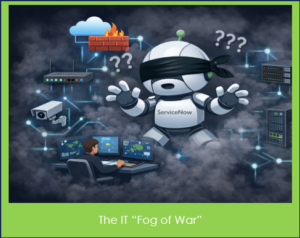 Time and experience have both helped and hindered the evolution of ServiceNow Discovery. On the positive side, Discovery’s ability to identify nuanced attributes of applications, devices, and CIs has dramatically improved. Years of deployment experience across industries have fed back into refining patterns, sensors, and probes, making modern application discovery smarter and more context-aware. ServiceNow is widely considered one of the most advanced device discovery solutions in the industry, covering a variety of vendors and device types including but not limited to servers, desktops, network systems, storage devices, backup systems, and applications.
However, network discovery has not seen the same evolution as ServiceNow scans blindly rather than plugging into the network fabric. This is because ServiceNow emerged at a time when IT operations largely viewed networks through the lens of legacy practices inherited from their roots in military and research infrastructure associated with the Defense Advanced Research Projects Agency (DARPA), an era that framed network discovery as a security problem to be solved through brute force IP sweeps. That legacy persists. ServiceNow Discovery still relies heavily on administrators to supply IP address ranges, then proceeds to scan those ranges aggressively regardless of actual network activity or change.
Make ServiceNow “Network Aware”
Most organizations use static discovery ranges, manually updated to reflect infrastructure growth. But networks evolve dynamically, and without automation, new subnets can quietly go unscanned, leaving assets unmanaged and invisible. Finding these parts of the network is called network discovery.
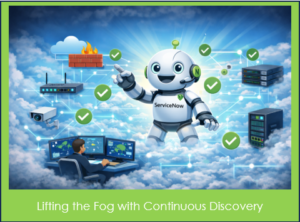
Organizations can push beyond ServiceNow’s defaults by making the platform truly “network aware.” One advanced method leverages the extensible pattern framework to tap directly into routing protocols like Border Gateway Protocol (BGP) and Open Shortest Path First (OSPF). While ServiceNow can populate its network tables with route data, this approach goes further, monitoring routing changes to detect when new IP blocks appear or disappear, then automatically updating IP range records and through custom JavaScript generating new Discovery Schedules. It shifts routing visibility from passive data to active coverage. The result is fewer blind spots and faster discovery of new infrastructure, but achieving this requires custom development, deep networking knowledge, and integration with core routing sources.
For most teams, a more accessible alternative is leveraging ServiceNow’s native integrations with tools already embedded in network and infrastructure workflows. Cloud platforms like Amazon Web Services (AWS), Microsoft Azure, and Google Cloud Platform (GCP) expose defined IP ranges and regions. Virtualization platforms like VMware vSphere reveal host and guest relationships. Endpoint and asset management tools like Microsoft System Center Configuration Manager (SCCM), IBM BigFix, or Jamf Pro (JAMF) provide dynamic inventories of systems under management. By ingesting this information, ServiceNow can create discovery schedules that reflect what’s actually in use, automatically adjusting to reflect real infrastructure changes.
Whether through custom routing integration or plug-and-play data sources, the goal is the same: elevate Discovery from static scanning to responsive, context-aware automation. This intelligence doesn’t just reduce operational overhead, it builds a more complete, trustworthy foundation for downstream compliance, security, and service mapping. It makes ServiceNow “Network Aware.”
Continuous Discovery as a Foundation for Trust
ServiceNow Discovery provides the connective tissue between environments and the CMDB, but it’s more than infrastructure mapping. It’s a living process that captures the ever-changing state of the enterprise.
Discovery continuously scans on-premises and cloud environments to identify compute, network, storage, and application infrastructure. It works hand-in-hand with integrations like Service Graph Connectors, AWS Config, or Azure Resource Graph to ensure nothing escapes visibility. That includes assets in hybrid networks, ephemeral containers, shadow IT, and even rogue Virtual Machines (VMs) in unauthorized regions.
What sets ServiceNow Discovery apart isn’t just what it finds, but what it enables after the scan.
Data from Discovery flows into the CMDB, where it’s reconciled, normalized, and enriched via the Identification and Reconciliation Engine (IRE). That means every discovered item is uniquely identified, deduplicated, and attached to the right class and service.
This forms the secure foundation for every module that depends on accurate asset intelligence:
- Governance, Risk, and Compliance (GRC) and Security Operations (SecOps) use the CMDB to scope controls and respond to threats.
- IT Service Management (ITSM) and IT Operations Management (ITOM) rely on it for incident response and impact analysis.
- Cloud Management uses it for policy enforcement and lifecycle control.
In essence, Discovery doesn’t just populate the CMDB, it activates it.
Why it Matters: Security, Risk, and Compliance Outcomes
When Discovery runs continuously, organizations benefit from more than up-to-date asset lists, they gain real, measurable improvements in security posture and audit readiness.
- Unauthorized Asset Detection
Continuous Discovery can reveal systems that were provisioned outside of process, such as rogue developer VMs, forgotten lab environments, or untracked cloud services. These assets represent blind spots for security tools and are often the entry point for attacks. By surfacing them in real time, teams can reclaim visibility and enforce governance before these assets are exploited.
- Vulnerability and Threat Exposure Management
Vulnerability scanners and threat intel tools are only effective if they have the correct asset targets. If a scanner misses a server or inspects an outdated version, it leads to false confidence. ServiceNow ties Discovery directly into Vulnerability Response, ensuring that CIs are always current, scanned regularly, and linked to real-time CMDB records with ownership, service context, and dependencies.
- Faster Incident and Breach Response
When an incident occurs, context is everything. Is this server critical? Who owns it? What does it support? What else does it talk to? ServiceNow’s integration between Discovery, CMDB, and SecOps ensures that alerts and security incidents come pre-packaged with this context, allowing teams to move from alert to impact analysis to response in minutes, not days.
- Control Mapping and Continuous Audit Readiness
Compliance doesn’t just require clean data, it requires proven oversight. With Discovery feeding the CMDB constantly, and with automated data attestation in place, GRC and Audit Management can demonstrate that controls are mapped to real systems, tracked continuously, and updated automatically. This supports frameworks such as International Organization for Standardization (ISO) standards, the National Institute of Standards and Technology (NIST) framework, the Sarbanes–Oxley Act (SOX), and other frameworks that demand not just governance, but evidence of governance.
- Policy Enforcement and Drift Remediation
Through integrations with Cloud Management and ITOM, ServiceNow can detect when assets drift from known good states, appear in non-compliant locations, or violate tag and label policies. Continuous Discovery enables proactive enforcement, not just during provisioning, but as things change, move, and decay. In practice, this reduces configuration drift and helps enforce architecture standards across all environments such as development, test, and production (Dev, Test, and Prod).
- Operational and Strategic Impact Awareness
Using ServiceNow ITOM and Strategic Portfolio Management (SPM), organizations can go beyond technical asset tracking to understand broader business implications. When a server or device fails, Discovery and Service Mapping reveal cascading application dependencies and regional impact zones. ITOM surfaces real-time service health impacts, while SPM ties these disruptions to business capabilities, cost structures, and strategic initiatives. This alignment ensures not only faster remediation, but also better executive decision-making, translating infrastructure visibility into enterprise value.
Discovery Tools That Power Security and Compliance
ServiceNow provides a suite of capabilities to position Discovery as a frontline control in your security and compliance strategy:
- Discovery Schedule and Patterns: Run automated, credential-based scans across data centers, clouds, and hybrid environments with thousands of out-of-the-box (OOTB) patterns for hardware, software, containers, and more.
- Identification and Reconciliation Engine (IRE): Ensure every discovered item is matched correctly and updated consistently, avoiding duplicate records or shadow CIs.
- CMDB Health Dashboard: Monitor data completeness, correctness, and compliance, especially for security-critical CI classes and high-value business services.
- Service Graph Connectors: Integrate external data sources (like SCCM, AWS, Qualys, Tenable, or CrowdStrike) to expand visibility and enrich CIs with security-relevant data.
- Attestation and Certification: Validate ownership and data accuracy for systems under compliance scope, and schedule regular checks to meet audit needs.
- GRC and SecOps Integration: Link discovered and classified assets to business services, risk registers, and security incidents, providing full traceability.
- Software Asset Management (SAM): Identify unlicensed or non-compliant software installations across discovered infrastructure, enabling action before audit violations occur.
- Cloud Management and Governance: Detect policy violations like region misplacement, tag misuse, or provisioning outside approved templates, and trigger workflows to remediate them.